
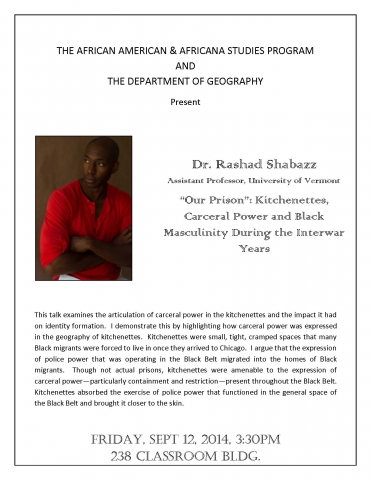
Rashad Shabazz: "Our Prison": Kitchenettes, Carceral Power and Black Masculinity During the Interwar Years
This talk examines the articulation of carceral power in the kitchenettes and the impact it had on identity formation. I demonstrate this by highlighting how carceral power was expressed in the geography of kitchenettes. Kitchenettes were small, tight, cramped spaces that many Black migrants were forced to live in once they arrived to Chicago. I argue that the expression of police power that was operating in the Black Belt migrated into the homes of Black migrants. Though not actual prisons, kitchenettes were amenable to the expression of carceral power—particularly containment and restriction—present throughout the Black Belt. Kitchenettes absorbed the exercise of police power that functioned in the general space of the Black Belt and brought it closer to the skin.
Date:
-
Location:
238 Classroom Building
Event Series:
Film viewing and discussion of The Other Boleyn Girl with Susan Bordo
Watch the movie and join in a discussion of fact versus fiction with Susan Bordo, author of the best-selling The Creation of Anne Boleyn and the instructor of a brand new general education course, "Anne Boleyn in Fact, Fiction, and Fantasy".
Film viewing begins at 3:00pm followed by discussion

Date:
-
Location:
Young Library Auditorium
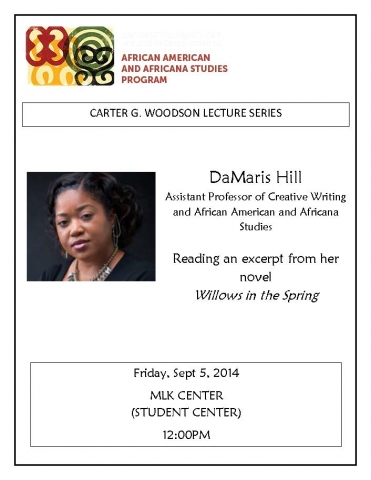
Carter G. Woodson Lecture Series: DaMaris Hill
AAAS presents the Carter G. Woodson Lectures Series.
DaMaris Hill, Assistant Professor of Creative Writing and African American and Africana Studies, will read an excerpt from her novel Willows in the Spring.
Date:
-
Location:
Martin Luther King Center (Student Center)
OPSVAW Supports Five Students
One of the top priorities of the OPSVAW is the support of students, and the 2014-2015 academic year will see the program support five students through graduate fellowships and research assistantships.
The "Arab Spring" in Social Media: Possibilities and Perils in a Networked Age
While the role of social media has been feverishly debated in fomenting, planning, and sustaining revolutions since twitter was first hailed—somewhat exaggeratedly—as a revolutionary technology in Moldova in 2009 and YouTube became a people's archive for election protests in Tehran during the summer of that same year, it seems incontestable that broadcast media (often singular, uni-directional, and hierarchical) are being supplanted by decentralized, multi-directional "public utterances" from social media. The result is a significantly more adaptable, amorphous, global, but also ephemeral public sphere. However, even with the best intentions, social media can amplify misinformation on a global scale, creating an echo chamber of falsehoods that are easily accepted as truths by virtue of their sheer repetition. And more ominously, social media can be tracked and used to squelch the very voices that use it. In this talk, Todd Presner will discuss a series of projects that analyze the role of social media in the Middle East, starting with the 2009 Tehran election protests and going up to the 2011 "Arab Spring," including twitter projects such as the "Voices of January 25th" (Egypt), "Voices of February 17th" (Libya), and HyperCities as examples.
Todd Presner is Professor of Germanic Languages and Comparative Literature at the University of California Los Angeles. He is the Chair of UCLA’s Digital Humanities Program and also the Sady and Ludwig Kahn Director of the UCLA Center for Jewish Studies. With Anne Burdick, Johanna Drucker, Peter Lunenfeld, and Jeffrey Schnapp, he is the co-author of Digital_Humanities (MIT Press, 2012). His most recent book is HyperCities: Thick Mapping in the Digital Humanities (Harvard University Press, 2014), with collaborators David Shepard and Yoh Kawano. Projects can be seen at this website: http://thebook.hypercities.com.
A reception will follow the program in the Alumni Gallery.
Date:
-
Location:
UKAA Auditorium, William T. Young Library
Event Series:
UK Professors' Book Highlighted in HuffPost Blog
"A Positive View of LGBTQ: Embracing Identity and Cultivating Well-Being" by professors Sharon Rostosky and Ellen Riggle was one of two books focused on as exhibiting the importance of identity in the LGBTQ community.
Shanghai University Hosts UK Faculty Second Year in a Row
University of Kentucky faculty will spend two weeks teaching and presenting research in China.
Knocked Up and Locked Up: Pregnancy and Prisons in Literature and Law
The Fall 2014 course will examine the political, racial and social contexts that pregnant women in prison experience.