How I Teach It: "Teaching Intersectionality: Highlighting the Strategies and Stories of International Graduate Instructors"
In this series we celebrate and discuss the ways that scholars around campus teach complex gender and women's studies concepts like feminisms, gender, sex, and intersectionality among others. A 30-45 minute discussion/presentation of pedagogies, challenges and controversies by the scholar(s) is followed by a Q&A with the audience.
This session's these is "Teaching Intersectionality: Highlighting the Strategies and Stories of International Graduate Instructors"
How I Teach It: How I Teach about Gender and Health as a Historian"
In this series we celebrate and discuss the ways that scholars around campus teach complex gender and women’s studies concepts like feminisms, gender, sex, and intersectionality among others. A 30-45 minute discussion/presentation of pedagogies, challenges and controversies by the scholar is followed by a Q&A with the audience. After which we will celebrate with light refreshments.
Dr. Mel Stein is a feminist historian and interdisciplinary scholar specializing in race, gender, and sexuality in science and medicine. She is the author of Measuring Manhood: Race and the Science of Masculinity, 1830-1934 (University of Minnesota Press, 2015), an intersectional analysis of scientific racism in nineteenth and early twentieth century America that interrogates biomedical constructions of citizenship, investigates the relationship between racial and sexual sciences, and examines scientists’ attempts to offer medical solutions to the nation’s “race problems.” Her teaching and research interests include health and health disparities, racial thought, the cultural constructions of the body, the history of sexuality, African-American and gender history, feminist science studies, race and policing, and the politics of memory.
Discussant- Dr. Anastasia Todd, is an Assistant Professor of Gender & Women’s Studies at UK. She is the author of Cripping Girlhood (Forthcoming, University of Michigan Press). She teaches classes on feminist theory, affect theory, the body, and disability.
Sponsored by the Department of Gender & Women’s Studies
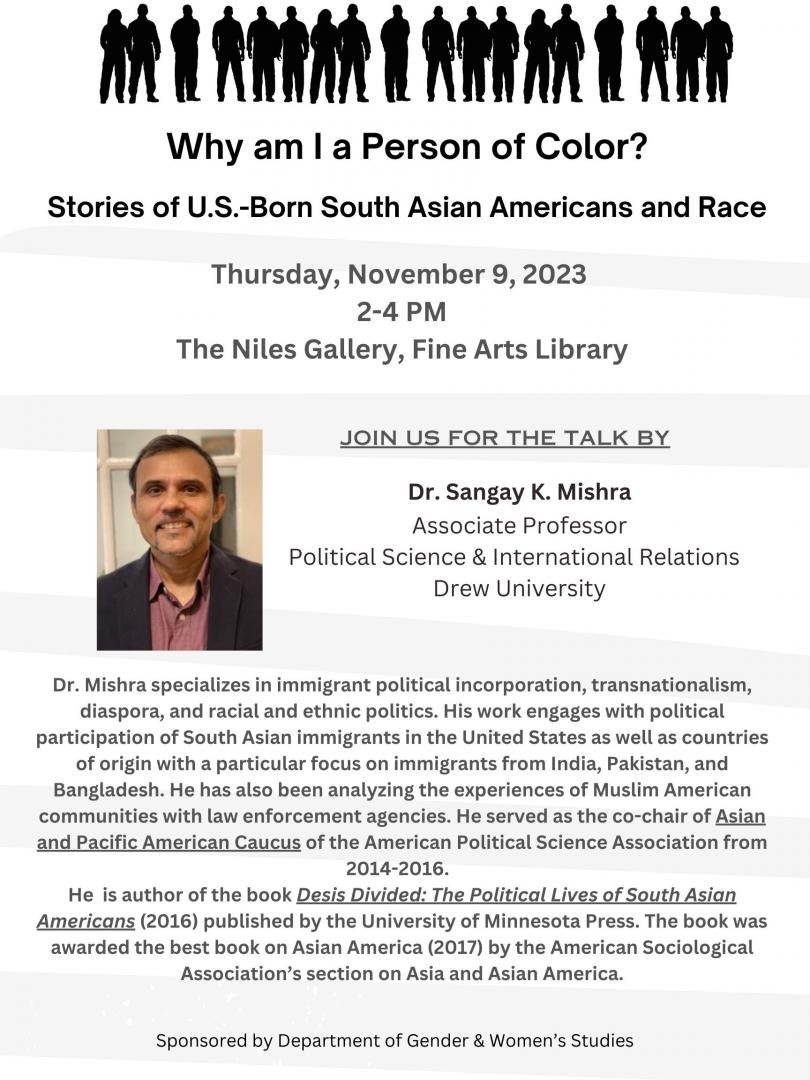
Why am I a Person of Color? Stories of U.S.-Born South Asian Americans and Race

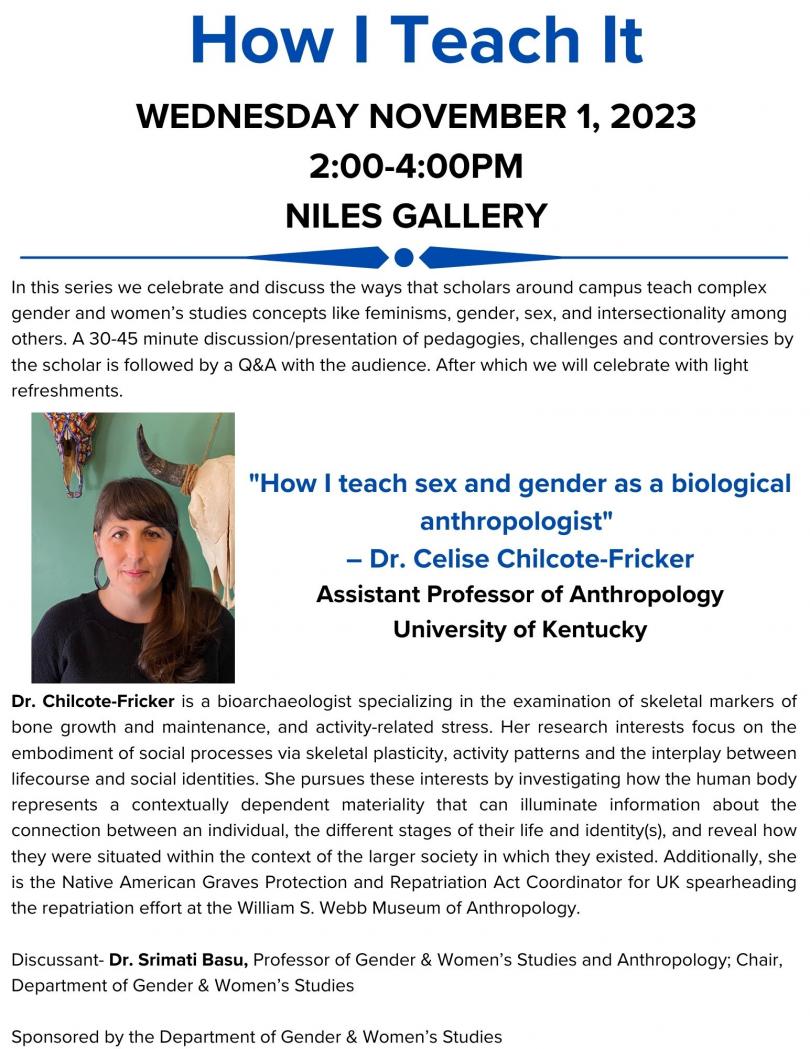
How I Teach It: How I teach sex and gender as a biological anthropologist

"Cogito, Ergo Sumus? The Pregnancy Problem in Descartes's Philosophy.”
The Philosophy Department in collaboration with the Department of Gender & Women's Studies and the UK Gaines Center for the Humanities is hosting our second undergraduate talk of the semester! Monday, October 9th, join us in Chem-Phys Bldg Rm 153 at 3pm! Maja Sidzińska from University of Pennsylvania is speaking on “Cogito, Ergo Sumus? The Pregnancy Problem in Descartes's Philosophy.””
Abstract:
Given Descartes’s metaphysical and natural-philosophic commitments, it is difficult to theorize the pregnant human being as a human being under his system. Specifically, given (1) Descartes’s account of generation; (2) his commitment to mechanistic explanations where bodies are concerned; (3) his reliance on a subtle individuating principle for human (and animal) bodies; and (4) his metaphysics of human beings, which include minds, bodies, and mind-body unions, there is no available human substance or entity that may clearly be the subject of pregnancy. The incompatibility of any of the three options found in commitment 4 with commitment 1, 2, or 3, together with other undesirable consequences should any be selected, results in what I call the pregnancy problem. The pregnancy problem is a previously unconsidered problem for the Cartesian philosophy. Given the pregnancy problem, commitment 1, 2, 3, or 4, or a combination of these would have to be revised for Descartes’s system to avoid a variety of tensions; alternatively, counterintuitive consequences may have to be accepted. Ironically, given Descartes’s interest in generation and medicine more generally, the Cartesian framework struggles to accommodate pregnancy in human beings. This may have implications for the systematicity and sex-neutrality of dualist metaphysics in general.

Queering Community & Kinship in Educational Spaces: A Symposium in Honor of Mel Lesch
Registration for this event is required. Please register here to attend in person: https://docs.google.com/forms/d/e/1FAIpQLSfqFmZauo7L1nLq21P2R8aSZvqK6XhXjCSmbrt_vndX1kM2-g/viewform
You can also attend by zoom: https://uky.zoom.us/j/81138477526
Schedule
8:30 to 9:00 AM: Registration
9:00 to 10:30 AM: Panel 1 - Remembering Mel Lesch and their work
Speakers: Dr. Shawna Felkins, Dr. Charlie Zhang, and Dr. Karen Tice
Moderator: Kirsten Corneilson
10:30 to 11:00 AM: Refreshment Break @ Alumni Gallery
11:00 AM to 12:30 PM: Panel 2 - Mutual Aid and Community
Speakers: Dr. Miles Feroli, Lee Mandelo, Lukas Bullock, and Atticus White
Moderator: Shawna Irissarri
12:30 to 1:30 PM: Reception @ Alumni Gallery
1:30 to 2:45 PM: Keynote Session
Keynote Speaker: Dr. Sayan Bhattacharya
Moderator: Shruthi Parthasarathy
2:45 to 3:00 PM: Refreshment Break @ Alumni Gallery
3:00 to 4:00 PM: Awarding of Honorary Degree